


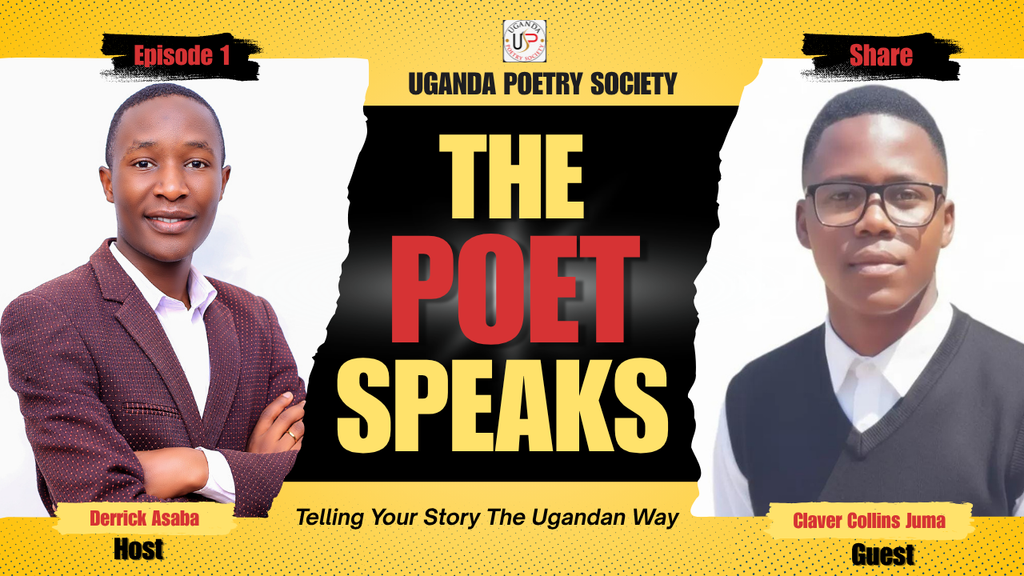
Imagine being part of the Uganda Poetry Society but watching your work go unnoticed. It’s a frustrating reality for many and feels incomplete. That is exactly why ‘The Poet Speaks’ was created: to give every Ugandan poet a platform to share their voice with the world. For our inaugural edition, Derrick Asaba sits down with Claver Collins Juma, the society’s Youth and Students’ Representative. Here is a look inside their conversation.
Asaba: Here we are, Collins. How does it feel to be our very first guest on the ‘The Poet Speaks’ series?
Juma: Honestly, it feels really special. Being the first guest on The Poet Speaks is an honour, but I also see it as a responsibility because the first episode sets the tone for what comes next. I am excited to have this conversation, not just as a poet, but as someone who is still learning, growing, and finding his voice. So, I am grateful for the opportunity, bro. Let us see where the conversation takes us.
Asaba: Well, since you have taken the mantle to set the tone, let’s roll. How have you been? What have you been up to lately?
Juma: I have been good, bro. Life has been moving, and honestly, I have been moving with it. Lately, I have been quite busy with poetry and the Uganda Poetry Society, especially with the responsibilities that come with my role as the Youth and Students’ Representative.
I have also been writing, reading, meeting different people in the literary space, and learning a lot along the way. I’m at a point where I am trying to grow not just as a poet, but as a person and someone who can contribute something meaningful to the poetry community. So yeah, a lot has been happening. Some days are poetry, some days are responsibilities, and some days are just me trying to figure out what life is saying.
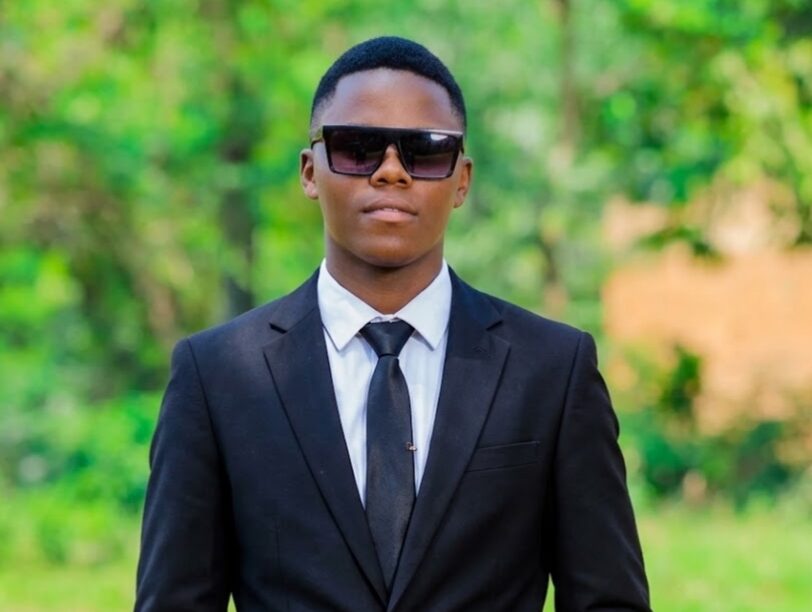
Asaba: Someone reading this chat and seeing your face for the first time might be wondering why we decided to host you. To delete the bias, could you please let us know who you are?
Juma: I am Juma Claver Collins, a poet, writer and literature enthusiast, currently pursuing a Bachelor’s in Education, Literature and English at Kyambogo University. I am someone who has always found a strange kind of home in words. Sometimes I write because I have something to say, and sometimes I write because the words refuse to leave me alone.
Beyond writing, I am currently serving as the Youth and Students Representative of the Uganda Poetry Society, where I get to interact with young poets and contribute to the growth of our literary community. I am also the Membership Director of the Rotaract Club of Kyambogo University. I am a strong believer in service above self.
But if you ask me who I really am beyond the titles, I would simply say I am a young man still figuring life out, observing people, collecting stories, making mistakes, learning, and turning some of those experiences into poetry.
Asaba: Eh! It’s like I am talking to someone else. But it’s good that I am getting to know you even more. That would be incomplete without this: Paint for us a picture of your education journey to date.
Juma: My education journey started in Mbale City. I went to Happy Hours Academy in Indian Quarters, where I studied from Baby Class all the way to Primary Three. I then joined Nabuyonga Primary School, still in Mbale, and continued from Primary Four to Primary Seven. For secondary school, I joined Mbale Secondary School for Senior One. After that, I was sent to a boarding school, and honestly, that part of my educational journey was very difficult. I don’t really like talking about that experience because it was a period I found extremely hard, and I would rather leave it in the past.
Eventually, I joined Kyambogo University, where I am currently pursuing my degree in Education, majoring in Literature and English. And looking back, my journey has not been perfectly smooth, but every stage has contributed something to the person I am becoming.
Asaba: Wait, at some point I thought you were from the central region. Tell me I was wrong.
Juma: I have had the chance to live in different places and experience different environments.
Asaba: So where do you hail from? New Delhi? We would like to know your lineage too.
Juma: New Delhi? Please, let’s not internationalise me before I even get famous. I am from Namayingo District, Eastern Uganda. That’s the headquarters of this particular human being.
Asaba: Now I get you. Did your poetic story begin from there as well? Take us back in time how it all started: poetry.
Juma: Actually, I wouldn’t say I first fell in love with poetry. I first fell in love with Literature, and poetry came later. I remember when I was still very young, around eight years old. It was around the period of the presidential campaigns, sometime between 2011 and 2013. My mum and I had gone to one of the rallies, and I remember seeing Olara Otunnu speaking. What really caught my attention was the way he spoke English.
I was this little boy wondering, “What does it take for someone to speak English like this?” So, I asked my mum, and she told me, “You have to first fall in love with Literature.” Of course, at that age I had no idea what Literature really meant. She explained to me that Literature involved reading books, so I started reading. And as I read, I discovered that Literature had different genres, and somewhere along the way I encountered poetry. That was when something clicked for me.
There was something about poetry that felt different. It communicated with me in a way I found difficult to explain. It was calming, but at the same time it gave me a space to express myself. I could take things I was feeling, things I couldn’t necessarily say out loud, and put them into words. So, funnily, I could say Otunnu didn’t directly introduce me to poetry. But his English, and one question I asked my mum because of it, eventually led me to Literature, and Literature eventually led me to poetry.
And here I am today, still talking to words as they owe me rent.
Asaba: That was quite amazing. It shows the magnitude our words carry even when we least know what they are preaching about us. So, what was your first poetic piece about? How Otunnu’s English birthed the love of Literature in me or something else?
Juma: (laughs) My first poetic piece actually goes way back to Primary Seven. But at that time, I honestly did not even know what I was doing.
I think I had this idea that poetry was something for a certain kind of person, not necessarily for an ordinary human being like me. I would read poems written by other people and then look at mine and think: Eh, these people are writing poetry; me, I am just arranging English words.
My first piece was about Uganda. It was really just me trying to express how I saw my country and the things I felt about it. Most of the early things I wrote were also quite personal, drawn from experiences I was going through and things I observed around me.
But I did not think those poems were good enough. Compared to what I was reading, mine felt very substandard to me. So, in Senior Two, I actually gathered the courage to do something very dramatic. I burnt the poetry collection I had written.
Looking back now, that is probably one of the funniest and saddest things about my early writing journey. I was so convinced that the poems were not good enough that I literally destroyed the evidence.
Asaba: You shouldn’t have burnt them; that was your poetic foundation. Anyway, we shouldn’t be crying over spilled milk. So how did that experience shape your eventual years of poetry?
Juma: Yeah, years later, I came to understand that sometimes the person who judges your work most harshly is yourself. And honestly, I still struggle with that. I still judge myself. I still look at my work and feel like it is substandard, like there are still holes in me and in my writing, like I have not quite reached where I want to be.
But the difference is, I don’t give up. I have kept writing. I have become more comfortable experimenting with words, with my own experiences, the people around me, society, and the things that touch me personally.
And I think along the way I came to understand what poetry really means to me. Poetry is about how you feel. How you see yourself, how you embrace your experiences, and how you interpret the world around you. We don’t all feel the same things, and we don’t encounter life in the same way. So naturally, we cannot all write the same poetry.
For me, poetry doesn’t have to be perfect. Sometimes it has to be raw. It has to carry the emotion before it carries the perfection. And perhaps that’s why, even when I still feel like my work isn’t quite there, I keep putting words on paper. Because I am still learning my voice. And maybe the poet I am becoming is somewhere in all those imperfections.
Asaba: Definitely. How far are you willing to stretch on this poetic journey?
Juma: Honestly, as far as this journey allows me to go.
Asaba: Hmmm! Let me not outstretch you. About leadership, I realise more of your roles are people-centred. Youth and Student’ Representative with UPS, then Membership Director with Rotaract club of Kyambogo University. Any special reasons why?
Juma: I think for me, leadership is something that has always been in me. By God’s grace, I find myself in leadership positions. I have led in church, I was a school leader, I was my former school’s Information Minister, and now I find myself serving in the Uganda Poetry Society and Rotaract club of Kyambogo University.
But first of all, I believe leadership comes from God. I think He gives people different abilities and different ways of serving others. My mum has also played a big role in nudging me towards leadership as I was growing up.
And then Interact and Rotaract gave me a deeper understanding of what leadership really means to me: Service Above Self. I love service. I love people. I love helping people; I love seeing people happy, and I genuinely enjoy being able to contribute something to someone else’s life. So, when I look at these positions, I don’t really see them as titles. I see them as opportunities to serve.
I believe leaders are born, and then life shapes them. Because the instinct to step forward, to help, to organise, to speak for others- I think that was already in me. The experiences just gave me places to exercise it. At the end of the day, if people around me are doing better and are happier because I played a small part, then that’s leadership to me.
Asaba: That’s brilliant. As we come to the end of this conversation, what is that one thing that you wish many people knew about you but they don’t?
Juma: What people don’t know about me is that I am actually a prayer warrior. Behind the poetry, jokes and leadership, there is a Collins who believes in prayer very seriously. Prayer and I are almost five and six.
Asaba: Prayer warrior… That signals something deeper. As far as I know, people never just develop that habit. There is always a reason that pushes them that way. I am avoiding being direct so I don’t look like I am influencing your response. What led you to become a prayer warrior?
Juma: I was raised in a prayerful homestead, so prayer has always been part of my life. But as I grew older, I also got to see the wonders the Lord has done in my life and in my family. Some things you experience and you simply can not take God for granted. So, I keep praying, and most importantly, I keep thanking Him.
Asaba: Can you share a particular instance in your life where God intervened, and you are forever grateful? If you are okay with that.
Juma: Yeah, there is one experience that really stays with me. I was on a bodaboda, and we almost got into a very serious accident with a trailer. It was one of those moments where everything happens so quickly, and somehow, we escaped it.
And when I look back, I realise I have had other very close calls, maybe three serious ones, where things could have ended very differently. You hear stories of people getting into accidents like these and losing their lives, and then you ask yourself, “Why am I still here?”
I don’t claim to have all the answers, but those moments have made me deeply grateful to God. They make me feel that my being here is not something I should take for granted. And actually, that experience inspired one of my poems, I Have Seen Wonders. So, whenever I look back at those moments, I don’t just remember the fear. I remember to say, thank you, God, I am still here.
Asaba: It’s good that you are still here, and we will continue getting a taste of you — via poetry and leadership. One last word for our readers.
Juma: Keep writing, keep serving, keep believing, and above all, keep God in your journey. You never know what your little efforts are preparing you for. And remember, poetry does not have to be perfect. Sometimes it just has to be honest.
Asaba: Thanks so much, Collins for sharing your story with us. Blessings galore.
