
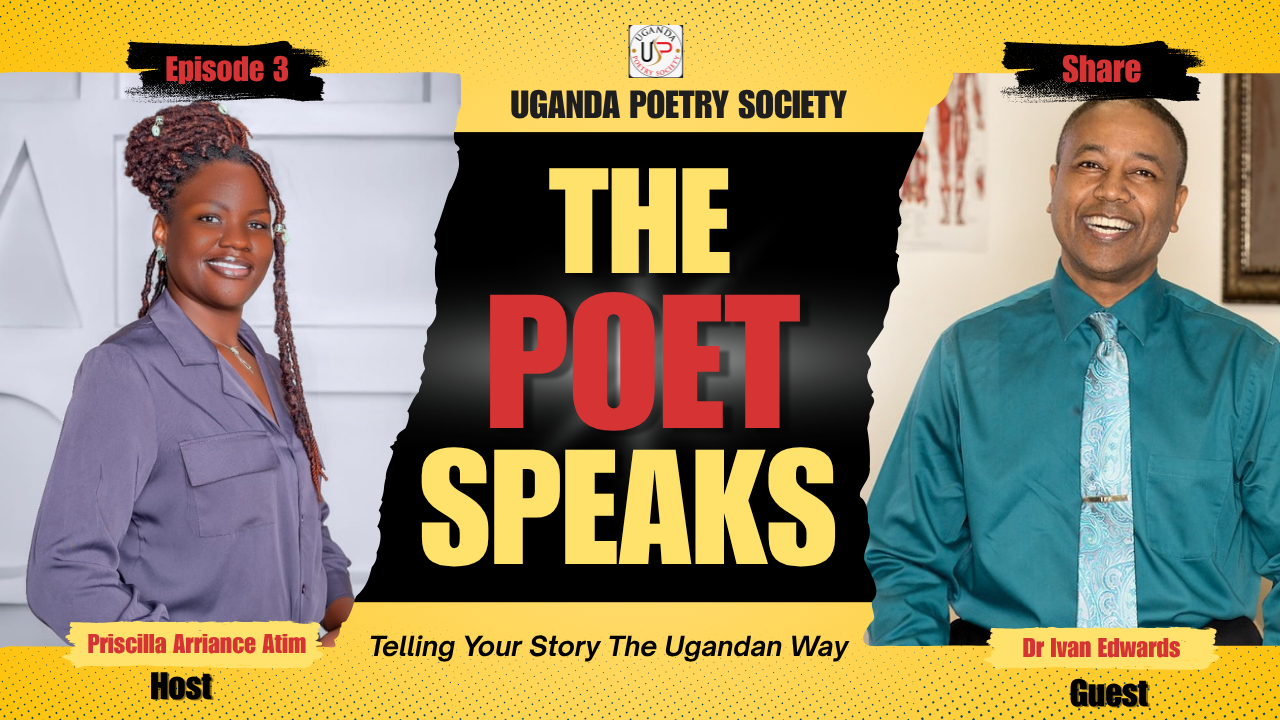
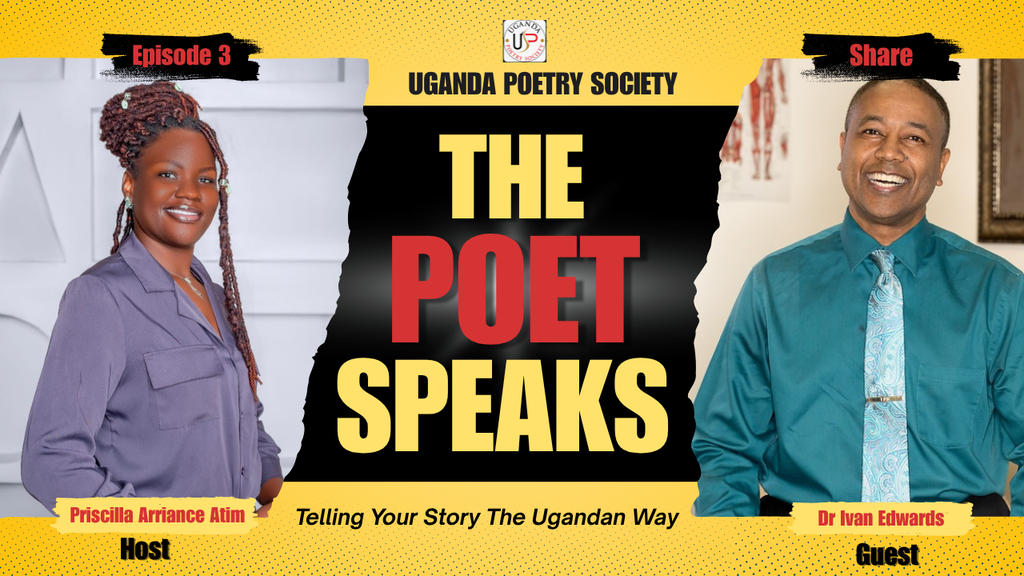
Welcome to the third episode of The Poet Speaks. This time, it’s hosted by the Uganda Poetry Society President, Priscilla Arriance Atim. In this inspiring exclusive, we sit down with Dr. Ivan Edwards, a Ugandan-born polymath who serves as a physician, U.S. Air Force Colonel, and flight surgeon. Dr. Edwards shares his captivating journey from writing childhood verses about the stars in Uganda to publishing his award-winning poetry collection, ‘Resonance of the Soul’. Read the full conversation below to experience a masterclass on how words become healing.
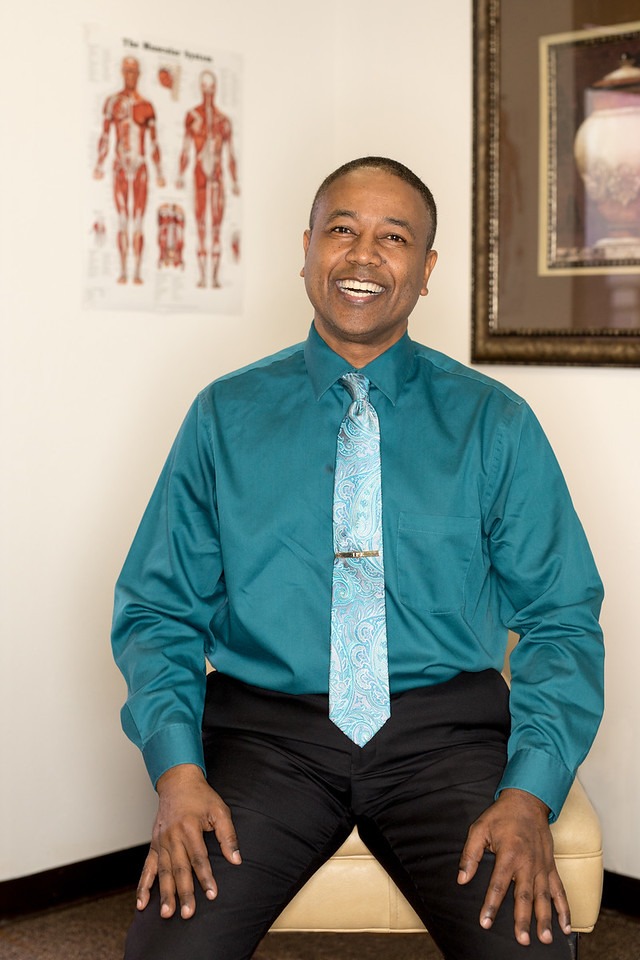
Atim: Hello Dr Ivan Edwards, as we begin this conversation, please kindly give us a brief background of yourself and your journey in poetry.
Dr Edwards: Well, I was born in Uganda, where I attended primary and secondary school. Later, in 1988, I immigrated to the United States. I went through university, medical school, internship, and residency training after becoming a medical doctor, and eventually joined the U.S. Air Force, where I now serve as a Colonel and Flight Surgeon.
I have always wanted to write, ever since I was a boy. But I was not truly exposed to poetry until secondary school in Uganda.
My English literature teacher told me that “poetry is rich. It uses repetition, imagery, metaphor, emotional compression, and reflection.” I will never forget those words.
He said poetry lets you explore abstractions, and I loved that. For instance, he once told me the color purple can speak of richness and depth.
He used to say a lot: “poetry is good for your brain.”
Poetry, and being a poet, is one of the hats I wear as a polymath. It is a way to think, to feel, and to translate and express the unseen into words.
Atim: So, that means you always write your poems down.
Dr Edwards: Yes. I would have papers on me all the time, and I still do. I write things down, and I still do.
When something comes to mind, I write it down before it leaves my mind. And sure enough, I keep my notes religiously.
Atim: Do you still remember the first piece that you wrote?
Dr Edwards: Yes. My first poem was to a young lady when I was about sixteen or seventeen years old. That was my first official poem.
But before that, when I was probably about six or seven years old, I would write about the elements, the sun and the stars.
I wrote about the sun:
The sun is beautiful.
Bright.
It gives us
light and energy.
And we grow.
And I would play on those words.
I not only liked poetry, but I also liked to put rhythm behind my poems, behind my lyrics. And that occurred from about six or seven years old all the way to about fifteen.
Atim: Wait, did I hear you say that when you were six or seven, you were already writing poetry?
Dr Edwards: Yes, ma’am. I grew up in a home where my grandfather expected us to read encyclopedias early in life, and to learn new languages. I began writing in single lines.
For instance:
The sun.
Beautiful.
Sheds its light,
bringing warmth and strength.
When I was a young man, I would say things like that aloud. It used to irritate my brothers because I made the words come alive, as they say.
I loved language, its rhythm, its music. I was drawn to imagery, metaphor, and abstraction. Those became the tools through which I expressed how I saw the world.
Atim: That means yours came from a point of love. From the time that you were young, it has been love for poetry that makes you do that.
Dr Edwards: Yes.
Atim: Alright. How about your favourite piece? The piece that you have written and you really love so much.
Dr Edwards: As I said, I will be honest with you. I was about sixteen or seventeen years old, and I saw this lady who I thought was the most beautiful woman I had ever seen.
Atim: So, you wrote a poem about her.
Dr Edwards: Yes, I did. And I gave it to her. She read it, looked at me, and said she was not a poet. She had no idea what I was reading. She asked, puzzled, if it was from me and if I had written it.
Atim: But was she impressed by it?
Dr Edwards: Yes, she looked at it, laughed, and said I had a lot of things in my head. I told her I could not help it.
She took the paper and never gave it back. I was expecting that. You see, in those days, we did not have copies. We did not have phones as you have now. No cell phones. Nothing.
She took it, and I never saw it again. But I still remember some of the words I wrote.
Atim: And some of them went like.
Dr Edwards: Oh my! I guessed you were going to ask that. I knew it. Here is a fragment:
She walked,
and the earth watched.
I watched too.
She looked at me today.
Nature stood still.
I did too.
When she spoke,
both nature and I
melted together.
It was emotional (laughs).
Atim: So, who are some of the poets you look up to?
Dr Edwards: I like Maya Angelou. I love her work. When I was at the university, she came around town, and I attended her event. I have read almost all of her work, and Caged Bird still sends chills down my spine.
Atim: You have such a love of poetry.
Dr Edwards: Yes, I do. I love poetry. I love it because it speaks life. You can place so many messages inside it, and I love that.
Atim: Have you published any of them?
Dr Edwards: Yes, I have published some of them, and I am about to publish even more. I am thinking of joining hands with other poets to see what we can do, perhaps amass all of that into an anthology.
Atim: That is such a great vision.
Dr Edwards: Yes. I have been out there publishing, and now I am intrigued. There are areas of poetry I want to go into because poetry is also about healing, growth, identity, and many different dimensions of the human experience. I would like to explore its use in rehabilitation medicine.
Atim: So, you want to dive into those areas of poetry.
Dr Edwards: Yes. They are actually using poetry now for people who have had brain injuries.
Atim: They use poetry for healing.
Dr Edwards: Yes. People who have had strokes, or damage to the brain, people who have had accidents and sustained brain injury, poetry is used for restoration. Potentially, yes.
The research is out there.
Because of the abstractions poetry carries. That is how poetry can be useful to people who have had brain injuries.
For instance, you and I can make the colour blue talk. When we do that, poetry activates parts of the creative brain that associate with those images and metaphors.
That neuronal stimulation helps the brain think in ways it normally does not. And that triggers the restoration of neuronal firing.
Things are picking up. We have found that people who have had strokes with aphasias articulate better when poetry is introduced to them in therapy. They recover faster.
Atim: So, what are some of the messages that you would like to send out to other poets?
Dr Edwards: I want to motivate them never to give up. Always strive to be the best they can, improve their craft, and speak.
At this point, we also have to get together and let the world know that we exist. We have to develop our craft. And we cannot develop our craft in isolation.
Atim: True. Say that again.
Dr Edwards: I am a strong supporter of poetry. I love the Uganda Poetry Society. And I feel that it is time for us to get together. We cannot operate in separate camps. This camp, that camp. We all need to come together.
We need to see things come into the arena. I would love to see a Uganda Poetry Society Journal, where we bring three or four poets together and publish a quarterly issue. Just like the Budo Review, we can have the Uganda Poetry Society Review.
Atim: Visionary indeed. That is going to be so important and impactful.
Dr Edwards: Yes, because guess what it does. When I was growing up, we wrote on paper. Now, we have the authority. We can get together, write our work down, and publish it. Over time, that review gains credibility because it is associated with an organisation.
I am full of ideas. I have ideas that float here and there.
I do not know what the word limitation is.
Atim: I am putting that in my notebook. Limitations are only here.
Dr Edwards: But we can get around them, go around them, below them.
Atim: What is the discipline that you have for your writing?
Dr Edwards: I wake up every morning and write a little something. I say, I woke up this morning feeling down, but I tell myself to rise and walk. You are quite the poet.
Guess what. I put it on Facebook or TikTok, wherever it is, and it is going to uplift somebody else.
Now, we have to go a step further as poets. This is what we have to do.
In order for people to know our craft, we have to put it into action. For instance, I saw your performance. You did not just speak it. You acted it out, laced with emotion. And it made me tear up a little.
So, when I read a line, I have to make the words jump out from the paper. When I read a line or a verse, it has to leap off the page. It has to become a living line, a line or verse brought into reality, into action.
I put emotion into my freestyle poetry because poetry, in itself, has emotion behind it. The words are not flat. If the emotion of the word is such that you are down, you are down. And when the emotion rises, you rise. It has to be alive.
Atim: Wait. Have you recorded videos of yourself doing poetry?
Dr Edwards: Yes. I have recorded some poetry. I have amassed quite a bit of work on YouTube, and I have managed to put action behind some of the poetry I publish. One of the first poems I wrote is First Love. If you Google it, you will find it. First Love.
I did not put my image there because I wanted people to catch the spirit of the poem, the actual words. I did not want to obstruct the words. I wanted the words to speak for themselves. So, when I recorded it, I put pictures there.
Atim: Tell the world something personal about your relationship with wine.
Dr Edwards: Wine slows life down. It teaches you to see, listen, taste, and then feel.
I do not drink wine.
To some, so I am told, wine is a companion to reflection. A companion to creativity and truth. I do not know that personally.
Atim: Explain.
Dr Edwards: I do not drink wine, as I said. But I relate to it poetically. When I talk about wine, I consider the essence. I strip it the same way I strip words. I take an idea, examine it, break it down, and look for what is inside.
Just like I take the word closing and pull out sing, sin, gin, in, I do that with concepts. I ask myself what is in here, what meanings or significance, what emotions or wisdom, what is worth transmitting.
So, when I speak of wine, I am not speaking as someone who drinks it. I am speaking as someone who understands its symbolism. Wine has layers, just like words. You peel it back, and suddenly you find something unexpected. Something personal.
Atim: Besides poetry, what else do you like doing with your time?
Dr Edwards: A lot of things. I am a very active person. I like nature. I walk. I enjoy the simple things in life. I like to drink a cup of chai when the sun is setting. I like the sunrise and just to watch it. I like the simple things in life.
I like to dance, not regular dance as people do, but just to dance, even out of step, as a testimony of freedom.
I like listening to people’s stories. And I like taking care of people. I am a doctor, after all. And to me, that is not work.
Sometimes it is simply listening to others.
Atim: What do you wish African writers should have access to?
Dr Edwards: I think we should now have access to publishing our work. African writers should start publishing their work, and start doing things that celebrate the African craft more.
What do I mean by that? You know African writers are storytellers. They do a lot. It is natural. You go to the village, and you hear an elder telling you a story, and the story is like a parable.
We ought to look at that and develop it. We have to write it down. I cannot say this enough. We are not writing things down enough in Africa. And these stories are dying with people.
I am encouraging the poets, the writers. Let us write stories down. Let us publish them so they can become permanent.
And then let us look amongst ourselves. I have heard enough about poets from Europe and America. I need to now hear about poets from Uganda Poetry Society. And I need to hear from them now because the talent is there.
Atim: Where can some of your works be found?
Dr Edwards: I have a large digital footprint. My main vault is https://drivanedwardswriting.com/. That is where I post my poems almost daily.
I also have drivanedwardsbooks.com, where my books and collections are showcased.
You will find me on LinkedIn, on Facebook, and of course on my YouTube channel, The Convergence Point with Dr Ivan Edwards, where I share poetry, reflections, and inspirational content.
I have posted a few poems on PoetrySoup. And I have written a collection titled: Resonance of the Soul, Flowers and Harmonics, which is available online.
I write across a diverse range, but at the core of it all, I am a poet.
Atim: Is there anything else I have not asked that you would like to talk about?
Dr Edwards: Yes. We are actually going down another avenue that has come up. Fasihi Magazine, the publication arm of the Uganda Poetry Society.
We have also written some poetic stories that have emerged. That is an active publication arm. And we want to make sure that people publish their work, whether on the internet, in print, or stored, so that we leave a lasting representation.
Atim: Thank you so much for your time, Dr Edwards.